Welcome to DU!
The truly grassroots left-of-center political community where regular people, not algorithms, drive the discussions and set the standards.
Join the community:
Create a free account
Support DU (and get rid of ads!):
Become a Star Member
Latest Breaking News
Editorials & Other Articles
General Discussion
The DU Lounge
All Forums
Issue Forums
Culture Forums
Alliance Forums
Region Forums
Support Forums
Help & Search
General Discussion
Related: Editorials & Other Articles, Issue Forums, Alliance Forums, Region Forums
Reclaiming the Majority Is One Way to End Warrantless Surveillance

Flipping either one or both chambers of Congress could give Democrats enough leverage to force fair votes on privacy reform, but ending warrantless surveillance remains an uphill battle.
https://prospect.org/2026/06/24/reclaiming-majority-one-way-to-end-warrantless-surveillance/

From left, Sens. Mark Kelly (D-AZ), Mark Warner (D-VA), Senate Minority Leader Charles Schumer (D-NY), and Sen. Ron Wyden (D-OR) conduct a news conference in the U.S. Capitol, June 17, 2026. Credit: Tom Williams/CQ Roll Call via AP Images
When I reported out my first story on the fight over Section 702 of the Foreign Intelligence Surveillance Act (FISA) in March, it was an open question whether Freedom Caucus Republicans would succeed in linking the reauthorization of the government’s warrantless spying program to the Safeguard American Voter Eligibility (SAVE) Act, a Jim Crow–coded disenfranchisement bill that would require voters to provide proof of citizenship before registering to vote in federal elections. That was three months ago. Earlier this month, Democrats seemed poised to withhold their support for a 702 extension in protest of President Trump’s decision to name Federal Housing Finance Agency (FHFA) Director Bill Pulte as acting director of national intelligence (DNI). A procedural vote in the Senate to begin debate on Section 702 failed on June 5 amid the backlash over Pulte’s appointment, and the underlying statute lapsed at midnight on June 12.
But congressional Democrats didn’t end up taking FISA hostage; Donald Trump did. Last week, the president doubled down on his pledge to not sign any FISA-related legislation until Congress passes the SAVE Act. Trump’s comments came less than a week after he nominated U.S. Attorney Jay Clayton as permanent DNI, and on the same day as Clayton’s confirmation hearing, which the president instructed his nominee not to attend. Clayton, a longtime Wall Street lawyer who served as SEC chair during Trump’s first term, lacks the national security experience required of the role. He also recently appeared on CNBC’s Squawk Box alleging that there were major problems with recent elections in California after Trump baselessly suggested there had been fraud. But as my colleague Bob Kuttner observed, intelligence hawks still took the bait, welcoming Clayton’s nomination with open arms, until Trump put him on ice to get Pulte in there on an interim basis.
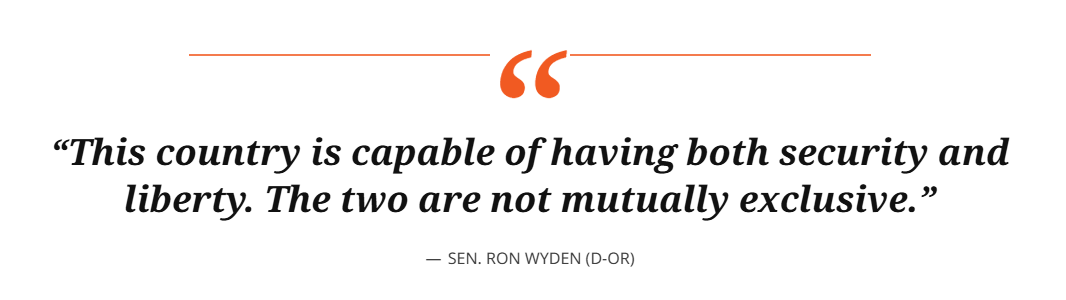
In an interview with the Prospect, longtime privacy advocate Sen. Ron Wyden (D-OR) said the only way to protect Americans’ rights is with “black letter law” that establishes a check on whoever is in power. “If Congress waits around for Trump now,” he said, “it is a recipe for bedlam.” Wyden’s view is that the appointment of Pulte, who has already begun firing intelligence officials deemed insufficiently loyal, is yet another reason why “every single Democrat ought to refuse to reauthorize Section 702 without new safeguards for Americans’ rights.” But in addition to his concerns over Pulte, whose potential for abuse is “almost unlimited,” Wyden believes many of the questions that have since been raised about Clayton are “appropriate.” “I’m the first United States senator in history to be elected by mail, so I’m very concerned about what Clayton has said publicly,” Wyden told the Prospect.
Negotiations over Section 702 reauthorization have stalled. Those hawkish Democrats are desperate to fold, but not until Pulte goes and 702 is separated from SAVE. The statutory lapse, which is unprecedented but does not end Section 702 wiretap authority by itself, could have been avoided if Republican leadership allowed fair votes on privacy reform. Instead, they attempted to ram through multiple 702 extension proposals, all notably lacking in meaningful Fourth Amendment protections, and struggled to navigate the chaos Trump has sowed with his DNI nominees and SAVE Act antics. The surveillance authority has been legally extended to next April, after the 2026 midterm elections. If Republican leadership will not relent in its efforts to pass a (mostly) clean extension of Section 702, what sense is there in Democrats ceding so much as an inch of ground in the fight over warrantless surveillance before they regain control of Congress?
snip
1 replies
 = new reply since forum marked as read
Highlight:
NoneDon't highlight anything
5 newestHighlight 5 most recent replies
= new reply since forum marked as read
Highlight:
NoneDon't highlight anything
5 newestHighlight 5 most recent replies
= new reply since forum marked as read
Highlight:
NoneDon't highlight anything
5 newestHighlight 5 most recent replies
Reclaiming the Majority Is One Way to End Warrantless Surveillance (Original Post)
Celerity
8 hrs ago
OP

Autumn
(49,038 posts)1. A fair vote? If they get the majority what exactly is a fair vote on privacy reform?
One the republicans will agree on? I don't think I've seen a fair vote since republicans have had the majority.