Environment & Energy
Related: About this forumCenturies of net-negative emissions required to secure a safe climate future
So… this means it’s someone else’s problem, right?
https://iiasa.ac.at/news/mar-2026/centuries-of-net-negative-emissions-required-to-secure-safe-climate-future
Both studies were led by researchers from the Exploratory Modeling of Human-natural Systems Research Group of the IIASA Advancing Systems Analysis Program and underline that achieving the Paris Agreement goals will demand durable commitments to large-scale carbon dioxide removal (CDR) extending far beyond current policy timelines.
…
The implications for policymakers are profound. Many countries projected to become wealthier after mid-century – while simultaneously facing increasing exposure to sea-level rise and permafrost thaw – have strong incentives to adopt more ambitious Nationally Determined Contributions (NDCs), establish explicit gross carbon dioxide removal targets, and introduce intertemporal instruments such as Carbon Removal Obligations to guarantee the reversal of temperature overshoot.
In summary, climate stabilization will require durable institutions that connect present emissions with future removals across generations.
…
Gasser, T., Rezai, A., Cheritel, C. et al. Negative emissions to mitigate Earth system risks. Nat Commun (2026). https://doi.org/10.1038/s41467-026-69896-x
 = new reply since forum marked as read
Highlight:
NoneDon't highlight anything
5 newestHighlight 5 most recent replies
= new reply since forum marked as read
Highlight:
NoneDon't highlight anything
5 newestHighlight 5 most recent replies

Norrrm
(5,558 posts)Need more studies and outlaw these two.
 ??? Not really.

OKIsItJustMe
(22,089 posts)But, “Net Zero” is not sufficient.
OKIsItJustMe
(22,089 posts)James E Hansen, Makiko Sato, Leon Simons, Larissa S Nazarenko, Isabelle Sangha, Pushker Kharecha, James C Zachos, Karina von Schuckmann, Norman G Loeb, Matthew B Osman, Qinjian Jin, George Tselioudis, Eunbi Jeong, Andrew Lacis, Reto Ruedy, Gary Russell, Junji Cao, Jing Li, Global warming in the pipeline, Oxford Open Climate Change, Volume 3, Issue 1, 2023, kgad008, https://doi.org/10.1093/oxfclm/kgad008
Eelco J Rohling, Anna S von der Heydt, Editorial on Hansen et al. ‘Global warming in the pipeline’ (this issue), Oxford Open Climate Change, Volume 3, Issue 1, 2023, kgad010, https://doi.org/10.1093/oxfclm/kgad010

CrispyQ
(41,089 posts)I knew the answer once, but forgot.
Reading social media comments on climate change memes is even more depressing than reading the ones on Trump memes. The ignorance & stupidity are astounding.
OKIsItJustMe
(22,089 posts)The “hopium” crowd (e.g. Michael Mann) would tell you the warming would stop immediately.
https://michaelmann.net/comments-on-new-article-by-james-hansen/
…
https://www.columbia.edu/~jeh1/mailings/2024/Hopium.MarchEmail.2024.03.29.pdf
Our paper, Global Warming in the Pipeline, was greeted by a few scientists, among the most active in communication with the public, with denial. Our friend Michael Mann, e.g., with a large public following, refused to concede that global warming is accelerating. We mention Mike because we know that he won’t take this notation personally. Accelerated global warming is the first significant change of global warming rate since 1970. It is important because it confirms the futility of “net zero” hopium that serves as present energy policy and because we are running short of time to avoid passing the point of no return. …
The recent release of a major study confirming that Global Warming is accelerating (I feel) shows who is correct in this disagreement among colleagues.
CrispyQ
(41,089 posts)Apparently, he's never cooked at all. 

NNadir
(38,530 posts)...soothsaying based on the usual vague handwaving. Of course, I'm just glancing at it, as I'm busy and I have a low tolerance for handwaving social sciencey stuff.
The paper is here:
Riahi, K. et al. The Shared Socioeconomic Pathways And Their Energy, Land Use, And Greenhouse Gas Emissions Implications: An Overview. Glob. Environ. Change 42, 153–168 (2017).
It's an open source; anyone can read it.
It contains this precious graphic with, um, "storylines."
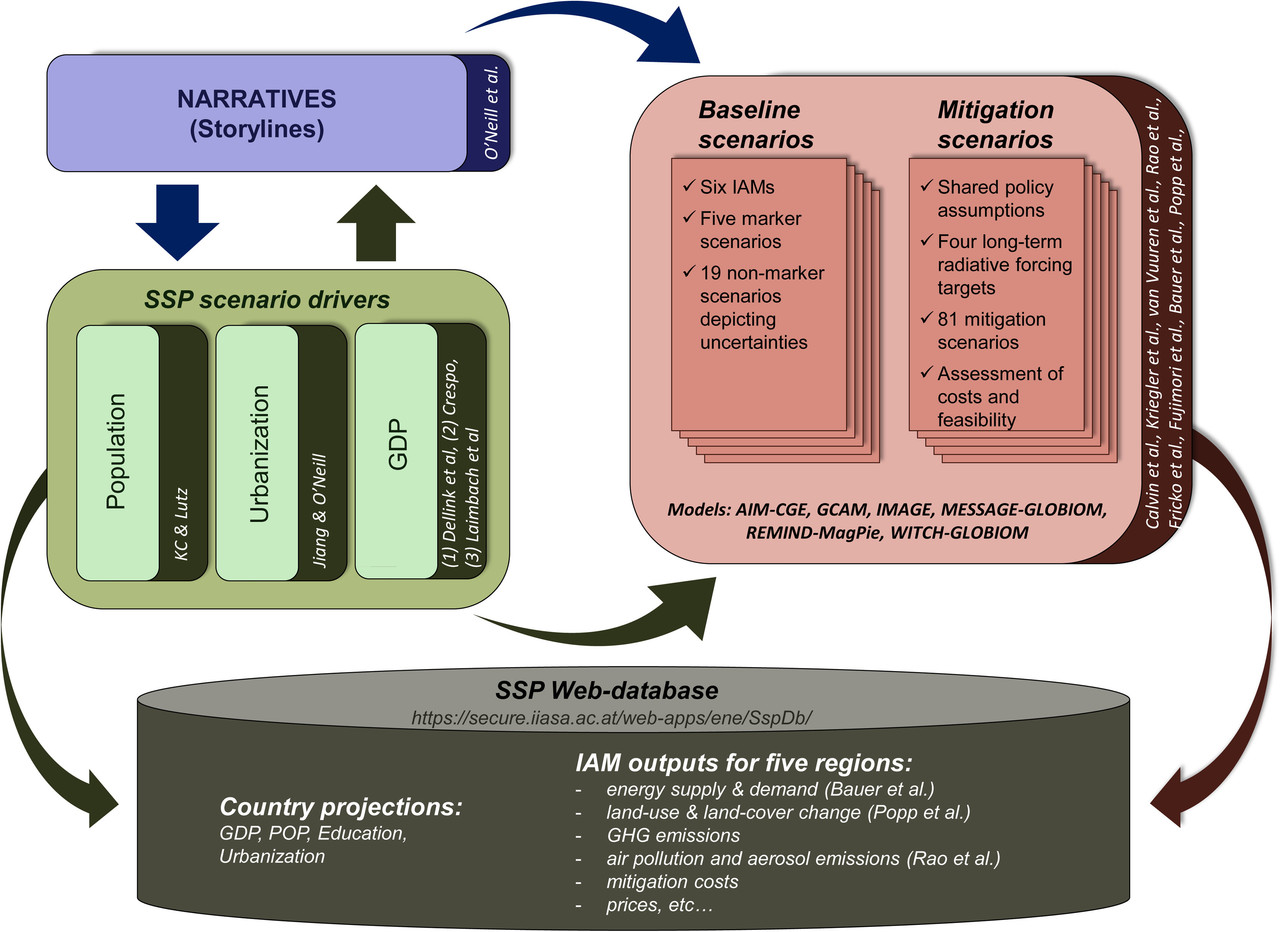
The caption:
Who wants to bet whether the "storylines" consist of vast stretches of industrialized wilderness for so called "renewable energy," oblivious of the unsustainable material cost, although there does seem to be some musings about land use? (Good luck with that.)
Whether it acknowledges somewhere in the field of references creative engineering using high temperatures, things like reverse Allam cycles, carbonate selective electrodes, process intensification us high nuclear generated temperatures, and straight up [link:Boudouard reaction| Boudoaurd chemistry] is not clear to me. It would probably be a waste of time to wade through internal references.
It doesn't matter really. The paper is from 2017, six years into the adventure in which antinukes and "I'm not an antinuke" antinukes were getting rashes from wedgies as they hoped someone would finally die from radiation exposure at Fukushima to justify their toxic and frankly, deadly, paranoia.
It's almost ten years later. Antinukism is finally, at long last, being relieved of its unjustified acceptance, perhaps way too late, but better way to late than not at all.
The removal and reduction of carbon dioxide from the environment takes energy, massive amounts of energy, energy to overcome the entropy of mixing, and reproduction of all the energy released in putting it there and then some to overcome the entropy term in the Gibbs free energy requirements.
This said, the engineering, while extremely challenging, with the challenges unlikely to be met, is still in the realm of the feasible if not in the realm of the simple.
As I near the end of my life, I am pained to realize what was possible but rejected.
Antinuke gloating over their success at demonizing nuclear energy is gloating over a crime against the future, one the future that has now become the present, and the future of all to follow.
History will not forgive us, nor should it.
Have a wonderful weekend.

thought crime
(1,786 posts)As renewable energy reaches industrial scale and benefits from economy-of-scale and further innovations, it may become the cheapest way to power carbon capture/ CDR.