Environment & Energy
Related: About this forumThe Biogeochemical Fate of the Long Lived Radioactive Fission Product Selenium-79.
The paper to which I'll refer in this post is this one: The Biogeochemical Fate of Se(VI) in Bentonite Systems Relevant to the Disposal of High-Level Radioactive Waste Max Rose, Samuel Shaw, Katherine Morris, Christopher Boothman, Matthew Bailey, Dirk Engelberg, and Jonathan R. Lloyd Environmental Science & Technology 2026 60 (5), 4124-4133.
I have some disagreements with the contents of the paper, beginning with the claim that we should dispose of so called "nuclear waste at all. I don't actually consider any component of used nuclear fuel - and I'm fairly familiar with all of them - to be "waste." I regard the word "product" in the term "fission products" to be a pun. To my mind fission products are valuable, but perhaps one of them, that discussed in this article 79Se could be problematic, in a way. Let's look at it a little deeper.
Let me quote from the paper's introduction to bring forth another bone of contention:
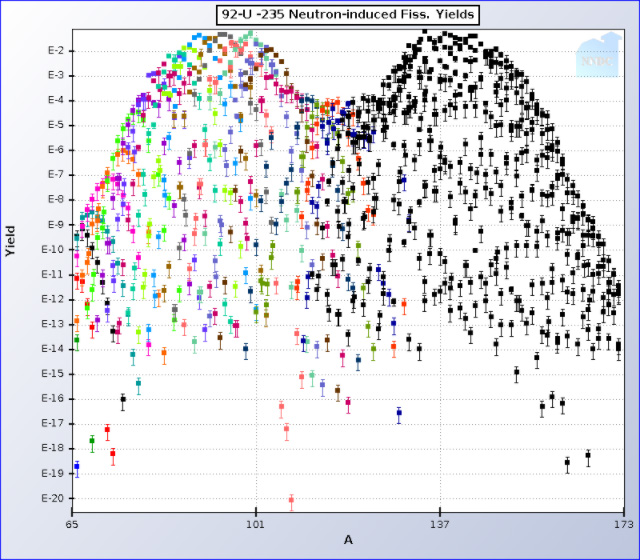
The italicized and bolded term "high yield" is wrong. The yield of 79Se is low compared to other fission products, almost to the point of triviality, which, as I will argue below, is somewhat unfortunate. The stable isotope associated with mass number 79 is 79Br, one of the two stable isotopes of bromine. Below are graphics, from the Brookhaven National Lab (BNL) Nuclear Data pages, showing the distribution of fission products for the two major fission sources found in a commercial light water or heavy water reactor with a mass number abscissa, 235U and 239Pu, the latter generated in situ in operations from neutron capture in the fertile but not critically fissionable isotope 238U.
235U:
239Pu:
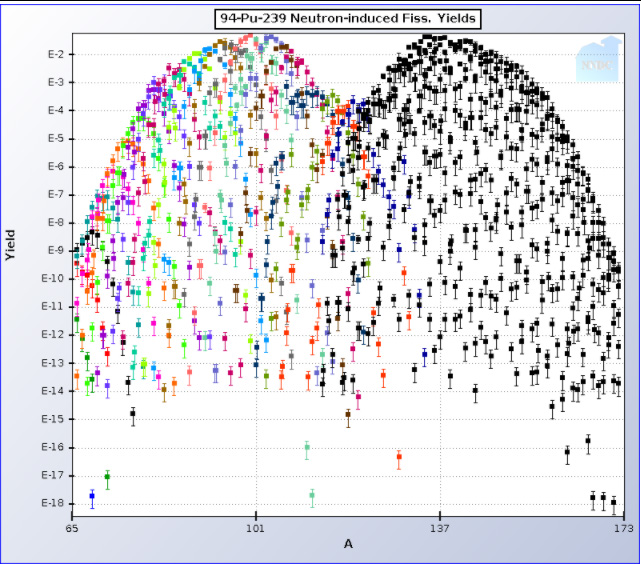
It is clear by using the logarithmic ordinate that the mass number in both cases at 79 amu, is at best a minor constituent of used nuclear fuel. In the case of uranium fission the initial elements initially formed at mass number 79 are 79Zn, 79Ga 79Ge, 79As, and finally 79Se, respectively highly radioactive and thus short lived isotopes, of zinc, gallium, germanium, and arsenic are elements in the decay chain leading up to 79Se which has a half-life of 3.27 X 10⁵ years. Only only tiny traces of the stable non-radioactive naturally occurring isotope of bromine 79Br will have time to form. (The result of the long half life of 79Se is that bromine found in used nuclear fuel is essentially monoisotopic 81Br, which makes it unique for isotopic labeling experiments for example in studying degradation mechanisms of toxic and persistent brominated flame retardants.) The Brookhaven data pages give the graphic data shown above numerically. The sum of the fractional yield of all fission products of mass number 79 can be shown, using this data for 235U to be 4.47 X 10⁻⁴ (0.047%) and for 239Pu, 2.29 X 10⁻⁴ (In asymmetric fission the left “hump” moves to the right as the atomic weight of fissioning nuclei increases, so that by the time isotopes of fermium, element 100, are encountered, the distribution is approximately a single “hump,” the fission product distribution is essentially symmetric.)
One can estimate from these figures how much 79Se is available for recovery from used nuclear fuel in the United States, variously reported as somewhere, after approximately 70 years of commercial nuclear power in the United States, at approaching around 90,000 metric tons. At modern burn ups about 95% of used nuclear fuel remains as unchanged uranium, 1% is plutonium with small amounts of neptunium and the higher actinides such as americium (depending on cooling time) and traces of curium, berkelium and californium. About 4% is fission products, suggesting about 3,600 tons. If we assume, ignoring some variances, that about half of the energy produced by nuclear fuel comes from 235U and half comes from 239Pu formed in situ – again a rough approximation, the yield of 79Se should be somewhere around 3.4 X 10⁻⁴, the US supply, ignoring decay because of the long half life, should be around 800 kg, collected over approximately 70 years. Fission will result in the formation of several of the stable and metastable natural isotopes of selenium, for example 76Se. 77Se, 78Se and 80Se as well as 82Se. The naturally occurring latter isotope has been discovered to be radioactive, but very weakly so, as its half-life exceeds the age of the universe. The total fractional mixture of isotopes of Selenium for uranium (235U) thermal spectrum fission, using fission yield data available at BNL, amounts to 5.27 X 10⁻³. For plutonium, 239Pu , the quantity is less, 1.03 X 10⁻³. This suggests that the roughly 800 kg 79Se will be suspended in roughly 5600 kg (5.6 tons) of nonradioactive selenium; about 14% will be the long lived radioactive isotope of interest. Elemental selenium has three allotropes having different densities, and the selenium coming out of used nuclear fuel will differ in its atomic weight from natural selenium because of its non-stellar fission source. However, as this is a “back of the envelope” calculation we can estimate the volume of isolated selenium by taking an “average” density of 4.4 g/cm3, close to the density of the alpha allotrope. This suggests that the US supply of fissiogenic selenium could fit in a little over 1.2 cubic meters, a box 106 centimeters on a side, which could easily fit into the bed of a pickup truck..
It is rather difficult to imagine that it would be harder to contain 1.2 cubic meters of anything indefinitely than it would be to contain the 37 billion tons of gaseous carbon dioxide, the dangerous fossil fuel waste, being released, at the current rate, each year by the use of dangerous fossil fuels.
There are seven fission products commonly found in used nuclear fuel that have particularly long half-lives, over 100,000 years. They are the aforementioned 79Se, (t1/2 = 327,000 years,) 93Zr (zirconium) (t1/2 = 1,600,000 years), 99Tc (technetium) (t1/2 = 211,100 years), 107Pd (palladium) (t1/2 = 6,100,000 years), 126Sn, (tin) (t1/2 = 230,000 years), 129I, (iodine) (t1/2 = 15,900,000 years) and 135Cs (cesium) (t1/2 = 1,300,000 years). To my mind, all of these isotopes have potentially useful applications, in several cases in nuclear applications. Technetium can replace its extremely rare but extremely valuable naturally occurring congener, rhenium in almost every application, for example, for the production of machinable tungsten alloys. (The world supply of technetium can easily be made to exceed that of rhenium.)
Of these isotopes, only one, the isotope of tin, 126Sn, is a strong emitter of highly penetrating gamma rays. Of course, if one thinks of this properly, one can recognize that gamma radiation is a particularly wonderful thing, since it can do things few other things can do, for instance cleave the strong carbon fluorine bond featured in atmospheric HFCs, and for that matter, water polluted with the otherwise intractable perfluoro organic substances, (PFOS) which are now generating enormous concern in the environmental community.
For this reason, the gamma emissions of 126Sn, along with the presence of selenium’s isotopes in used nuclear fuel including the long lived 79Se, which always comes out of used nuclear fuel with stable isotopes (as does tin), intrigue me. The reason can be found in this paper: (Insert RSC paper)
The main impediment to utilizing these isotopes rather than attempting to dump them somewhere, although the risk of nuclear dumps is vanishingly small, is economic, specifically that there isn’t very much of these materials available. Thus the scale at which they might operate is limited. The environmental superiority of nuclear energy to all other forms of primary energy is closely tied to the fact that the yield of these isotopes is very small. This said, an argument can, and should, be made.
It is important to note that the longer the half-life of a nucleon is, the less radioactive it is. Uranium’s main isotope, 238U, has a half-life that is roughly about the same as what is generally taken to be the lifetime of the Earth, about 4.5 billion years. Anyone who has a granite kitchen countertop is likely to have uranium in it, and yet people are not killed, nor their health impaired, by radiation from their countertop, nor by swimming in the ocean, which contains over 4 billion tons of uranium.
Because of historical practices in nuclear fuel reprocessing, as well as nuclear weapons testing most people on Earth have small amounts of highly mobile129I (iodine) in their thyroids, but thyroid cancer is rare compared to other cancers, notably that caused by dangerous fossil fuel waste (aka “air pollution” ), lung cancer. Rates of thyroid cancer in men does not appear in the top ten, in women, it is the eighth most common cancer, and in any case, thyroid cancer is rarely fatal, with cure rates exceeding 99%.
Antinukes and “I’m not an antinuke” antinukes around here like to carry on all the time about Fukushima, where the death toll from radiation was miniscule, if not zero, whereas the death toll from the Sendai earthquake natural disaster that destroyed the reactors along with a coastal city, was roughly 20,000, suggesting that coastal cities are more dangerous than breached melted nuclear reactors. For a period of time, in Japan, people shut well functioning nuclear reactors, thus killing people with fossil fuel waste, but there was no movement to ban coastal cities.
This is a point I make repeatedly in this space and elsewhere, living in coastal city is more dangerous than living next to a nuclear plant with melting fuel and a breached containment building.
Go figure.
Anyway. Let us turn to one of the 7 “long lived” fission products, the gamma emitting isotope of tin, 126Sn. Tin it turns out, forms a binary compound with selenium, SnSe, which is completely insoluble in water. It has an interesting property described in the following paper:
Zhao, Li-Dong and Chang, Cheng and Tan, Gangjian and Kanatzidis, Mercouri G. SnSe: a remarkable new thermoelectric material Energy Environ. Sci., 2016,9, 3044-3060.
A thermoelectric device is a device that converts heat directly into electricity with no moving parts. Devices of this type are not new; the Voyager spacecraft (among many other space devices) which was launched nearly half a century ago are still sending signals to Earth having left the solar system. The above paper reports on the properties of pure tin selenide and was published in 2016, about a decade ago. Further refinements of this system are the subject of one of my posts in 2022:
High ZT thermoelectric material by doping SnTe with copper and selenium.
From that text:
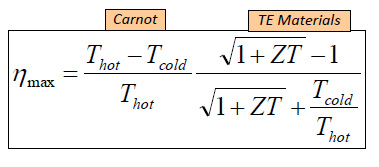
The thermal efficiency of an RTG is given by a formula utilizing a dimensionless parameter called "ZT" (it is not a product of two variables) according to the following equation:
ZT is determined by the following formula:
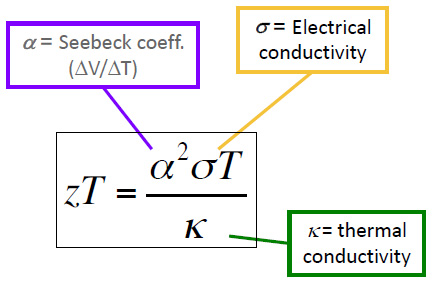
where S, σ, T, and κ are the Seebeck coefficient, (a property of the material) electrical conductivity, absolute temperature, and thermal conductivity, respectively. Note that the value of ZT requires that two variables which normally trend together, electrical conductivity and thermal conductivity - metals usually possess high values of both - must trend in opposite directions to maximize ZT.
The "State of the Art" RTG utilized on Curiosity is the MMRTG (Multimission RTG).
The value of the MMRTG is shown in the following graphic from a 2019 slide show given by Dr. Giacomo Cerretti, a post doc at JPL. The following is also from his slide show, showing where the MMRTG lies in terms of ZT and efficiency.
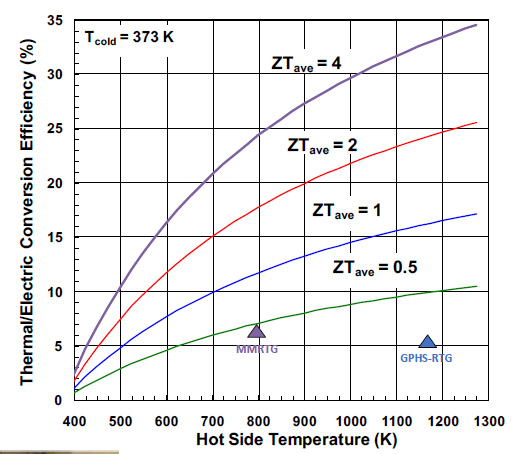
The MMRTG's thermoelectric material is lead telluride.
Right now, most of the used nuclear fuel in the United States is sitting in casks on the sites where it was generated. If one looks around the internet, one can find pictures of nuclear advocates hugging these casks to show that they are not particularly dangerous.
I find this containment in casks to be unfortunate; I would rather that the materials within them should be utilized including use to irradiate the air, since radiation has the effect of destroying certain classes of greenhouse gases other than carbon dioxide, notably residual CFC's that have survived since the signing of the Montreal Protocol as well as that present from cheating, the replacement HFCs which have very high warming potentials compared to carbon dioxide, as well as the ubitiquous contaminant that of growing concern, trifluoroacetic acid, the ultimate degradant of PFAS, as well as other volatile PFAS themselves.
What better way could there be to build casks designed to let air flow over a radioactive thermoelectric device containing both radioactive tin and radioactive selenium?
Recently I have been putting together some notes for my son on the idea of using transplutonium actinides, in particular americium, as nuclear fuels. Such use would be expected to produce curium isotopes, in particular 242Cm and 244Cm that demonstrate higher thermal output than traditional 238Pu plutonium isotope. (The former curium isotope decays to 238Pu.) I might add that there are many other fission products that might generate heat over long periods in thermoelectric devices. With these as a heat source, and the SnSe (doped or otherwise) material generating γ rays, these could provide continuous power at nuclear plants to provide uninterruptable power. I note that had the famous reactors at Fukushima's cooling pumps been powered with thermoelectric backup rather than diesel generators, they would have functioned quite nicely even inundated with seawater. As used nuclear fuel is already safely contained on site, surely thermoelectric devices could be similarly shielded in what would be essentially casks with free air flow.
Again, the limitation is that we don't really have enough radioactive tin and radioactive selenium to make this a broadly available technology, but in a better world, one where we were providing hundreds of Exajoules of nuclear energy as opposed to the 31 Exajoules now being produced, it could become a large scale undertaking, one that would have the effect of cleaning the air while operating.
Burying radioselenium, radiotin, or any component of used nuclear fuel strikes me as a dumb idea, if one has a shred of imagination. If one lacks an imagination of course, one can simply chant nonsense about "dangerous nuclear waste" even though - and I've tested this here many times with "honest to God" antinukes and the less than honest "I'm not an antinuke" antinukes - that there is no evidence, none, that the 70 year history of storing commercial used nuclear fuels has not killed anything like the number of people who will die in the next two hours from dangerous fossil fuel waste, aka air pollution, about 1600 people.
Hence, I think, with due respect to authors cited at the outset, that we really shouldn't give a rat's ass about the biogeochemical fate of fissiogenic selenium.
Nuclear energy is not only the safest form of industrial scale primary energy; it is also the cleanest form of industrial scale energy.
I trust you'll have a pleasant weekend.
 = new reply since forum marked as read
Highlight:
NoneDon't highlight anything
5 newestHighlight 5 most recent replies
= new reply since forum marked as read
Highlight:
NoneDon't highlight anything
5 newestHighlight 5 most recent replies

thought crime
(1,786 posts)Apparently the poster advocates using Nuclear waste to irradiate the air in order to destroy some types of greenhouse gas (not CO2).
"Right now, most of the used nuclear fuel in the United States is sitting in casks on the sites where it was generated. If one looks around the internet, one can find pictures of nuclear advocates hugging these casks to show that they are not particularly dangerous.
I find this containment in casks to be unfortunate; I would rather that the materials within them should be utilized including use to irradiate the air, since radiation has the effect of destroying certain classes of greenhouse gases other than carbon dioxide..."
What could go wrong?

NNadir
(38,530 posts)...with the scientific illiteracy of antinukes that they repeat insipid slogans which in their limited imagination they regard as wit.
They are far from wit.
The "what could go wrong?" junk slogan obviates the ethically vapidity of their ignorance and rather obviates their appalling indifference to what is going wrong with dangerous fossil fuels, the destruction of the planetary atmosphere from fossil fuel waste being only one example.
The paranoia and scientific illiteracy of the antinuke cults has left the entire planet in flames. To my mind, this morbid indifference to even a fragment of this vast planetary scale tragedy is appalling.
For the entire history of life on Earth, the atmosphere has been strongly irradiated. Regrettably, owing to the Maxwell-Boltzman distribution many anthropogenic pollutants, notably fluorinated and other halogenated gases tend to concentrate, owing to their high molecular weight relative to nitrogen and oxygen, near the Earth's surface rather than in the stratosphere and ionosphere, and thus low level irradiation in the troposphere can help to eliminate them more quickly than irradiation in the upper regions of the atmosphere.
There is almost no evidence in my experience that antinukes have ever opened a science book related to the physical chemistry of radiation, and yet they feel compelled to mutter nonsense in opposition to subjects about which they clearly know absolutely nothing.
To my mind this obviates an analogy to that dangerous fool Robert F. Kennedy muttering about vaccines. In many ways, antinukes are far more dangerous since dangerous fossil fuel waste, aka "air pollution," has killed far more people than the diseases that fool causes by his ignorance of vaccines.
The rise of antiscience rhetoric, of which antinukism is only one incarnation, has lead the world to a precipe from which an irretreivable fall is increasingly likely. It is tragic, almost unbelievably so.
History will not forgive us nor should it.
Have a nice day.
thought crime
(1,786 posts)Your contempt for non-scientists comes through loud and clear. We should indeed listen to scientists, but not only scientists, and we should certainly not listen too carefully to mad, bitter and paranoid scientists who lack the ability to factor in economic, engineering and social constraints and who blame current “anti-nukes” for cold-war propaganda about radiation backed up by the actual existence of nuclear exclusion zones and a lack of ability to solve the problem of nuclear waste in an acceptable way. Something tells me the general public, scientifically literate or not, is not going to accept the notion of using nuclear waste to irradiate the air. Yeah, call me stupid. Doesn’t matter because it just won’t happen. Neither will the completely unrealistic fantasy of a world relying solely on nuclear energy. That sounds a bit Edward Tellerish. A better way to manage your disappointment would be to lighten up and jump on the Fusion train.
Meanwhile, countries like China, Japan and Korea just got a new reason to reduce their dependence on oil and to continue innovative development of renewable energy and use of hydrogen fuel. And to go ahead and build some nuclear plants, too, if it helps.
NNadir
(38,530 posts)It's not optional. It's an ethical requirement. The future of the planet is at stake. Most of us take that seriously.
Got it? No? Why am I not surprised?
We had a "hydrogen will save us" idiot here for many months, about a year, I think recently, and I went to bat against the fossil fuel greenwasher lots of times.
Hydrogen, as anyone who has a faint familiarity with reality, is just that an effort to greenwash fossil fuels. Hydrogen is overwhelmingly made by the steam reformation of dangerous fossil fuels, about which, again, antinukes couldn't give a shit, It has been so for decades, going back to the first issue of the International Journal of Hydrogen Energy, published in 1976, when the concentration of the dangerous fossil fuel waste carbon dioxide was, in the week beginning March 7, 1976, 333.03 ppm.
As of this Sunday, it was reported to be, for the week beginning March 8, 2026, 429.91 ppm.
Volume 1, Issue 1, 1976: International Journal of Hydrogen Energy
I guess all the caterwauling over the last half a century about hydrogen has had no effect on the accumulation of dangerous fossil fuel waste other than to make it worse, which is unsurprising because the manufacture of hydrogen destroys exergy.
I covered this appalling "green hydrogen" fantasy many times here, by appealing to the science that antinukes so despise, for example: A Giant Climate Lie: When they're selling hydrogen, what they're really selling is fossil fuels.
The post contains reference to the laws of thermodynamics, laws that are not subject to change because of ignorance of them. They are physical laws.
Again, the situation is analogous to that of the jerk Robert F. Kennedy Jr., offering nonsensical opinions on subjects about which he clearly knows nothing at all. Nothing.
Nothing will begat nothing.
Have a nice evening.
thought crime
(1,786 posts)The baseless claim that "anti-nukes" don't care about fossil fuels, repeated ad nauseam, is simply false. In fact, it is just as likely that some "pro-nukes" don't care so much about fossil fuels. On another site, I have encountered very conservative maga climate denialists who are pro-nuke. Trump plans to aggressively expand nuclear energy. Does Trump care about fossil fuels? Well yes, he wants more.
If renewable energy can significantly replace use of fossil fuels, that is an improvement and part of a transition away from fossil fuels. If renewable energy can be used to replace use of fossil fuels in the production of hydrogen, and be used to expand the production of hydrogen to develop a larger and larger market for hydrogen, that is an improvement and part of the transition away from fossil fuels. The bits and pieces of technology are coming together to allow the emergence of the much ballyhooed hydrogen economy.
The argument that renewable energy doesn't work "because look fossil fuel demand is increasing" is completely flawed. You can say the very same thing about nuclear energy. It has been in use for many, many years but fossil fuel use increases. That's obviously meaningless.
Newsflash: We all have an "ethical requirement" to support the transition away from fossil fuels, using every tool and technology available and doing it in the safest and most economically viable way possible. We can't afford "my way or the highway" zealotry or extremely narrow-minded advocacy to one-and-only-one technology. "The future of the planet is at stake. Most of us take that seriously." Well then. You're either with us, or you're part of the problem.
Bonus:
Uruguay generates roughly 98–99% of its electricity from renewable sources, primarily wind, hydropower, and biomass, with solar expanding rapidly. The International Energy Agency (IEA) notes this transformation has resulted in a nearly decarbonized electricity grid, with 38% of total energy supply still coming from oil for transport.
With a hydrogen economy, that 38% coming from oil can be replaced with hydrogen and with a coastline on a large continental shelf, Uruguay and its neighbor Argentina will be Wind/Hydrogen powerhouses.
NNadir
(38,530 posts)Numbers don't lie.
Claiming that the trillions squandered on solar and wind is justified even if it has no effect on the use of fossil fuels is absurd on inspection.
The Germans have a climate intensity over the last year that is roughly one thousand percent in "percent talk" that of France. They didn't shut their coal plants to go with so called "renewable energy." They embraced coal. They shut their nuclear plants, despite the appeals of major climate scientists. The population of Germany is 83 million, the GDP is about 5 trillion dollars and stagnant because of high electricity prices. (The amount of money squandered on solar and wind in this century approaches that figure.) The population of Uruguay is 3.4 million people.wuth a GDP of around 80 billion, roughly between 1 and 2 % of Germany's in the "pecent talk" antinukes use all the time to obscure the grotesque expensive failure of so called "renewable energy."
If one wishes to claim ethical standing, a good place to start would be to avoid specious, dishonest arguments. If one wants to offer an opinion on a topic of vital importance to the future of this planet, one should know something about what one is deigning to speak.
I've been here for more than 20 years. In that time, I have never met an antinuke who is concerned about fossil fuels unless being called out on their indifference to them compared to their idiotic, and frankly dangerous - deadly actually since fossil fuel waste kills people whenever fossil fuels systems operate normally - attacks on nuclear energy.
I am not impressed by these types, their knowledge base, their education or their ethics, despite whatever disingenuous protestations they make to the contrary about themselves. Their selective attention is popular, perhaps, but it's killing the planet.
I explained the realities of the hydrogen scam here in terms that are referenced and delineated reality as it exists, not in some tiresome delusional fantasy world involving the conditional word "could" that antinukes throw around in their never ending indifference to reality. The word that matters is not "could," it's "is."
From my perspective we could have forestall much of this ongoing tragedy with respect for science and scientists. A simple knowledge of the laws of thermodyamics would be useful, even without requiring any knowledge of mathematics, simply by noting in plain language that "changing the form of energy wastes energy." Instead we've got a huge cabal of "Robert. F. Kennedy" type wannabes who offer insane ruminations on subjects about which they know nothing, babbling for instance with tiresome hydrogen nonsense a condition that could easily dismissed by repeating the aforementioned statement of the 2nd law of thermodynamics.
Consider me unimpressed.
thought crime
(1,786 posts)Germany’s mistake of shutting down nuclear plants and replacing with coal plants says absolutely nothing about renewable energy. Implying that it does have something to do with renewable energy makes this a “specious and dishonest” argument. In any case, Germany’s long term commitment to renewable energy (especially offshore wind) continues. Chancellor Merz doesn’t like “windmills”, but he isn’t completely insane.
Uruguay serves as a model that can be scaled up to larger countries. It is very possible that in the future, hydrogen will be exported from Uruguay and Argentina and many other countries to Germany and other large countries.
Your claim that “anti nukes” are generally not concerned about fossil fuels is simply that; a baseless claim. Even if it were true, it has nothing to do with the viability of renewable energy. It could be described as a specious argument but it’s not a very good one. And once again, invert the argument: D.Trump is, in terms of policy, a pro-nuke, but he loves fossil fuels. Does that tell us anything about renewable energy? Does that, in itself, mean nuclear energy is bad (because D.Trump loves fossil fuels)? No, Nopers, Negatory.
Your characterization of the vision of a very large hydrogen market as a scam because it doesn’t exist yet is just opinion. I get it; you are skeptical. I used the word “could” because I’m honest enough to be clear about hopeful speculation, but we do see a hopeful trend as renewable energy sources are beginning to be integrated with hydrogen production. If you are honest you will use the word “could” when discussing nuclear energy; it “could” save the world “if” everyone used nuclear energy as the sole energy source. The odds of that happening are probably even less than the odds of using renewable-generated hydrogen as a sole energy source, but you are entitled to your own “tiresome delusional fantasy”.
Most reasonable people do have respect for science and scientists, but the development of practical clean energy systems also requires respect for engineering, economic and social constraints. We give engineers some credit for applying proven technology to new problems. We can harness the power of the market to provide faster and more affordable paths to clean energy. We understand energy conversion uses energy but in many cases (e.g. transportation) the engineering and economic trade-offs favor conversion anyway. In these cases, we need to listen not only to scientists but also to the Dead Kennedy’s who said “Give me convenience or Give me death” (quote found in a programming book). The great economic advantage of Solar & Wind is the effectively limitless abundance and relatively simple access to energy. The abundance of Solar & Wind energy allows for energy conversion and storage in system design. BTW what is the nuclear energy solution for transportation? How would a world adhering strictly to the laws of thermodynamics power automobiles, tractor trailers, garbage trucks, trains and airplanes? For fun, I used the previous sentence as a query and my friend AI Overview returned an answer mentioning the terms “battery” and “hydrogen” several times. Now I have to choose who to believe; AI Overview or an unknown erstwhile scientist commenting on an obscure website. What to do? What to do? OK Yeah, this time I think I’m gonna have to go with AI Overview.
We need to understand and respect social anxiety that can sometimes be a barrier. For renewable energy and especially Wind, a social barrier is NIMBY. It exists in Hawaii where many locals and native Hawaiians object to plans for Offshore Floating Wind Farms, even though turbines would be placed ten miles or more offshore. They are really objecting to industrialization of the precious islands and ocean, which is understandable, and we should be sympathetic. But both Solar & Wind are great sources of energy in Hawaii and played a key role in enabling Hawaii to close its last coal-fired power plant in September 2022. The 185-megawatt Kapolei Energy Storage project uses massive lithium-ion batteries to store renewable energy and replace the grid stability previously provided by coal. Lithium batteries are not ideal, but that's an example of an engineering and economic trade-off. While some proposals have been discussed to explore new small modular reactors (SMRs) for energy security, the state is focusing heavily on a 100% renewable energy goal by 2045. For some like myself, the idea of using the Sun and the Tradewinds is a positive and hopeful vision in perfect balance with nature.
Social anxiety about nuclear radiation is related not only to Nuclear Catastrophes like Chernobyl, but to associations with nuclear weapons, the necessary Cold War propaganda, and even our personal experience with X-rays. No one wants to hear that they need “radiation therapy”. It all amounts to strong negative associations causing social stigma and anxiety that often tips the balance away from consideration of nuclear energy. Just declaring the stigma to be irrational doesn’t make it go away. Deal with it. And it will be interesting to see if the tech bros now running rampant with AI can push their way through this very understandable social anxiety to power data centers.
NNadir
(38,530 posts)For instance, as is the case with the OP, I have scientific issues related to environmental issues worth discussing with people who can grasp the point, something clearly not involved here.
I wish you a nice life.
This conversation is concluded permanently.
thought crime
(1,786 posts)
Caribbeans
(1,311 posts)Let me explain something:
You're the rudest poster I've ever seen on the net in 30 years.
I've never insulted you (or read any of your meandering blather) because it's a waste of time. I don't care a tiny bit what you "think" about H2, Nukes, wind or solar but enough already with the direct insults.
YOU put a lie to the tagline "Friendly forums for passionate Dems!", displayed at the top of every article posted here.
How this is allowed to stand in this forum is a disgrace.
Oh and by the way, what are the actual differences between your "energy policy" and those of Donald Dump? I don't think there are any. "More nukes, solar & wind are junk, etc etc"
Now GTF Back to your constant posting of insults and talk of how wind turbines are "junk". And keep calling fellow posters "idiots", your insults will be reported to the "management" - not that this will change a thing here but whatever.
ROFL you can lead a delusional decrepit old horse to water but you can't make it drink
NNadir
(38,530 posts)Last edited Thu Mar 19, 2026, 12:59 PM - Edit history (1)
It's unsurprising really.
If I were trying to convince someone that I pay no attention to what they say, it would be disingenuous and probably contradictory to repeat what the person says even in mangled form. It demonstrates poor rhetorical skills to do so.
Irrespective of any of that, it is a fact that hydrogen is overwhelmingly made from the steam reformation of dangerous fossil fuels with exergy destruction. Thus hyping hydrogen is pushing for furthering the destruction of the planetary atmosphere. In response to any effort to deny this fact, that pushing hydrogen is pushing fossil fuels, I can and do often, by appeal to the primary scientific literature demonstrate that this is well known and widely understood. It's never been a secret.
If there are people who find statements of facts, particularly when they are pushing toxic nonsense, to be insulting - and let's be clear efforts to rebrand fossil fuels as hydrogen is nothing if not toxic - this is hardly my problem.
In my ethics, it is dishonorable to coddle lies whether they are subtle or direct, particularly on issues of vast impact on a planetary scale.
I'm not interested in singing Kumbaya with people pushing destructive point and I'm less than interested in their personal opinion of me, whether rudely stated or rendered subliminally.
I'm a scientist, not a marketer of rebranded fossil fuels, and my more than 20 years of participation in this forum has always centered on issues connected with the degradation of the planetary atmosphere.
It is well known and widely reported that the production of hydrogen, chiefly for the manufacture of ammonia, is responsible for carbon dioxide emissions on a massive scale, around 2 to 3% of a level now having reached 37 billion tons per year in spite of endless solar and wind horseshit. All the slick high production marketing videos in the world have not and will not change that fact.
I will not be dissuaded from my advocacy of nuclear energy as the best tool for saving what is left to be save by petulant whining or by appeal to obvious logical fallacies.
Do I make myself clear?
No?
I couldn't care less.
Have a wonderful day.