Welcome to DU!
The truly grassroots left-of-center political community where regular people, not algorithms, drive the discussions and set the standards.
Join the community:
Create a free account
Support DU (and get rid of ads!):
Become a Star Member
Latest Breaking News
Editorials & Other Articles
General Discussion
The DU Lounge
All Forums
Issue Forums
Culture Forums
Alliance Forums
Region Forums
Support Forums
Help & Search
General Discussion
In reply to the discussion: Josh Shapiro Is No-Drama. But Is That What Democrats Want in 2028? [View all]
Celerity
(55,247 posts)6. Centrists: Better Things Aren't Possible
Third Way’s strategy session for Democratic moderates lacked any vision other than a hatred for progressives.
https://prospect.org/2026/03/10/centrists-better-things-arent-possible-democrats-south-carolina-third-way/

Democratic strategist Jim Messina, right, speaks as Third Way President Jon Cowan listens during Third Way’s “Winning the Middle” conference, March 2, 2026, in Charleston, South Carolina. Credit: Meg Kinnard/AP Photo
A group of Democratic Party moderates gathered in Charleston, South Carolina, last Sunday and Monday for an event organized by Third Way, an influential group in the party’s moderate wing. The event, entitled “Winning the Middle,” brought together elected officials, prominent pundits, data gurus, communication savants, and industry figures with one goal in mind: how to block a progressive from winning the party’s nomination for president in 2028. The event’s speakers celebrated their claim that a similar conference hosted by Third Way in the same location back in 2019 helped power Joe Biden—whom they touted as “the most conservative Democrat in the 2020 field”—to the White House, recalling that South Carolina served as both the last refuge of and launching pad for the then-former vice president’s flailing presidential campaign. With Democratic popularity at an all-time low, Third Way’s event hoped to galvanize a moderate resurgence and stave off any potential progressive insurgency.
What is immediately apparent watching the event is a total lack of any positive vision. Rather than propose a worked-out centrist platform, or even suggest opposition to the Trump administration, the event largely defined itself in opposition to the progressive wing of the Democratic Party.
The invite-only event (which was also broadcast on YouTube for me, and approximately 15 others, to watch live) opened with Third Way’s president, Jonathan Cowan, explaining that those gathered at the event stood opposed to, among other things, “open borders,” “modern monetary theory,” “land acknowledgments, identity politics, cancel culture, and more.” The goal of the gathering, as explained by Cowan, was to rebuild the Democratic Party into one that “can win the middle anytime, anywhere.” Winning, if the speakers are to be believed, is trivially simple. The only thing standing in the way of a resurgent Democratic Party that can win across the country—both in blue states and red—is a progressive wing that had soured the public on the Democratic brand.
Cowan’s agenda was almost entirely negative, focused above all on what his group is against. Explaining their health care vision, Cowan said that the assembled luminaries stood for “universal health care under the ACA, not Medicare for All and the end of private insurance.” While Cowan adopted the left’s rhetoric of “universal health care,” he failed to note that the Affordable Care Act not only has not achieved universal health care, but also only became net popular seven years after its passage, following an attempted repeal by the first Trump administration. The ACA was an improvement in many ways, but it was hardly the easy messaging win Cowan was making it out to be.
snip
WelcomeFest Wants Politicians Who Choose to Believe in Nothing
At centrism’s largest gathering, what was offered as the best path forward for Democrats is what sank their 2024 chances.
https://prospect.org/2025/06/10/2025-06-10-welcomefest-wants-politicians-who-choose-to-believe-in-nothing/
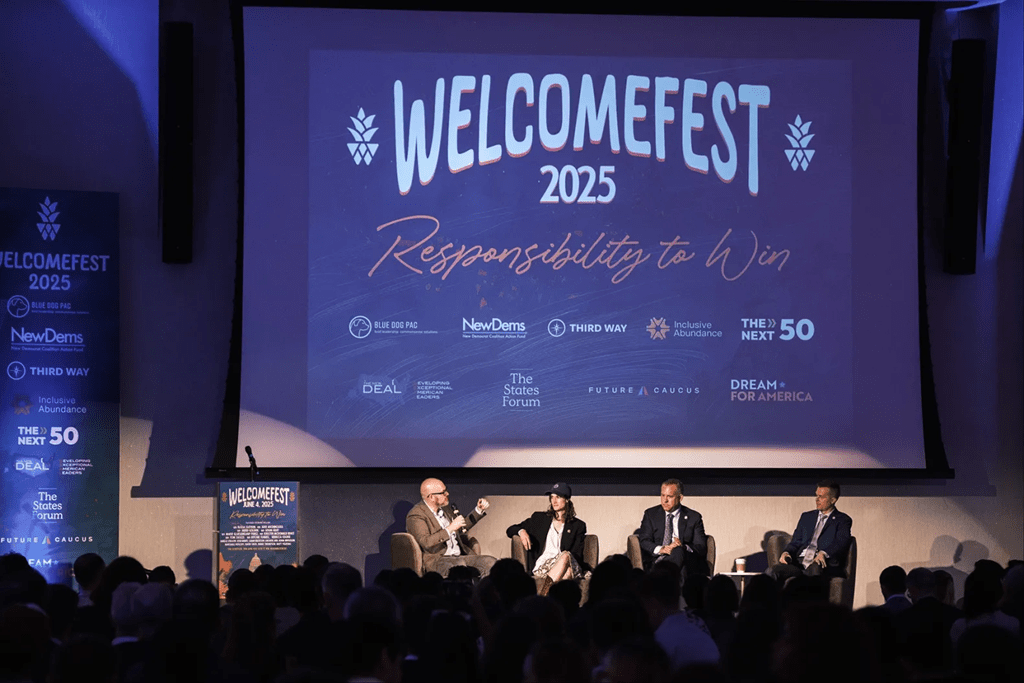
If the secret to winning elections is to believe in nothing at all except what focus groups approve of, then Future Forward should have been the most successful campaign operation in American history. The biggest outside spending arm in the 2024 election cycle, Future Forward raised across its super PAC and nonprofits a staggering $950 million, easily the most of any outside political organization in the last election, and almost certainly the most ever. The group appeared completely out of nowhere in 2020; Biden political maven Anita Dunn initially worried they were a new pro-Trump super PAC. But its funding base of Silicon Valley donors like Bill Gates and Reid Hoffman supported Democrats. And four years later, it was established enough to be the primary outside advertising force for Kamala Harris.
Future Forward was “probably the most analytics- and evidence-driven PAC I’ve ever seen,” a veteran of Barack Obama’s 2012 campaign told The New York Times. It promised “a ‘Moneyball’ method to political advertising,” in which thousands of messages would be tested in over ten million voter surveys and dozens of rounds of successive focus groups, to find exactly what combination of words, sounds, colors, and shapes elicited precisely the emotional response desired of the widest possible quantum of potential voters, cross-referenced by every demographic category, to once and for all solve politics. In 2024, Future Forward solicited hundreds of ads for Harris from dozens of Democratic ad makers, then whittled them down to produce those it found the most effective. In charge of the whittling process—and thus, the methodology for whether an ad was “effective” or not—was consulting firm Blue Rose Research, run by David Shor, the ever-ascendant pollster with Sam Bankman-Fried ties. Shor is the key theorist behind “popularism,” the idea that Democrats should exclusively talk about the parts of their agenda that poll well.
Shor’s theory of politics, then, had at its disposal the largest pool of funds in the history of elections, raised to win the most consequential race in the history of elections. Controversially, the group plunged almost all of its record-breaking budget into ads and analytics, and almost nothing into door-to-door field campaigning. It produced message-testing surveys, conducted deep analytics, cross-referenced the trusted data, then backwards-engineered what it determined to be “popular,” in order to make its candidate appear supportive of whatever it was currently optimal to appear supportive of. The result was that the Democrats, and Harris in particular, displayed their best selves, with scientifically engineered precision, in the messages with the greatest financial backing in 2024.
We already know what happened. Harris lost, Trump won, and American fascism dawned in earnest. Polling this year has found that 69 percent of voters say the Democratic Party is out of touch, and just 27 percent say Democrats are focused on helping people like them. A 56 percent majority say the party is not looking out for working people. Just 16 percent say Democrats are the party with stronger leaders—indeed, just 39 percent of Democrats say their party has stronger leaders—and only 25 percent view Democrats as the party of change. In short, people today don’t seem to trust the Democratic Party. There’s plenty of blame to go around for the 2024 election results. Stanley Greenberg laid out the intra-Harris campaign chaos in detail for the Prospect, and we have also stated our own gripes with Chief of Staff Jeffrey Zients and communications czar Anita Dunn. But clearly, if contemporary polls show that the public distrusts Democrats, then Shor, its messaging guru in control of the very core of Democratic strategy circa 2024, has not succeeded in optimizing the Democratic brand, even after being given virtually limitless resources to do so.
snip
Edit history
Please sign in to view edit histories.
Recommendations
7 members have recommended this reply (displayed in chronological order):
18 replies
 = new reply since forum marked as read
Highlight:
NoneDon't highlight anything
5 newestHighlight 5 most recent replies
RecommendedHighlight replies with 5 or more recommendations
= new reply since forum marked as read
Highlight:
NoneDon't highlight anything
5 newestHighlight 5 most recent replies
RecommendedHighlight replies with 5 or more recommendations
= new reply since forum marked as read
Highlight:
NoneDon't highlight anything
5 newestHighlight 5 most recent replies
RecommendedHighlight replies with 5 or more recommendations
Josh Shapiro Is No-Drama. But Is That What Democrats Want in 2028? [View all]
question everything
Sunday
OP
hanging the 'sh*tshow' on moderates and centrists is .... disingenuous ? (amongst other things)
stopdiggin
Sunday
#7
How exactly would the Republican "shitshow and corruption" not exist without the assistance of Democrats?
betsuni
Sunday
#8