Welcome to DU!
The truly grassroots left-of-center political community where regular people, not algorithms, drive the discussions and set the standards.
Join the community:
Create a free account
Support DU (and get rid of ads!):
Become a Star Member
Latest Breaking News
Editorials & Other Articles
General Discussion
The DU Lounge
All Forums
Issue Forums
Culture Forums
Alliance Forums
Region Forums
Support Forums
Help & Search

NASA Fires Up Powerful Lithium-Fed Thruster for Trips to Mars [View all]
Pardon me if this has already been posted:
https://www.jpl.nasa.gov/news/nasa-fires-up-powerful-lithium-fed-thruster-for-trips-to-mars/
NASA Fires Up Powerful Lithium-Fed Thruster for Trips to Mars
April 28, 2026
A novel electromagnetic thruster passed an initial test in a specialized chamber at JPL. With further development, these thrusters could support human missions to the Red Planet.
A technology that could propel crewed missions to Mars and robotic spacecraft throughout the solar system was recently put to the test at NASA’s Jet Propulsion Laboratory in Southern California. On Feb. 24, for the first time in years and at power levels exceeding any previous test in the United States, a team fired up an electromagnetic thruster that runs on lithium metal vapor.
This prototype achieved power levels beyond the highest-power electric thrusters on any of the agency’s current spacecraft. Valuable data from the first firing of this thruster will help inform an upcoming series of tests.
“At NASA, we work on many things at once, and we haven’t lost sight of Mars. The successful performance of our thruster in this test demonstrates real progress toward sending an American astronaut to set foot on the Red Planet,” said NASA Administrator Jared Isaacman. “This marks the first time in the United States that an electric propulsion system has operated at power levels this high, reaching up to 120 kilowatts. We will continue to make strategic investments that will propel that next giant leap.”
During five ignitions, the tungsten electrode at the thruster’s center glowed bright white, reaching over 5,000 degrees Fahrenheit (2,800 degrees Celsius). The work was conducted in JPL’s Electric Propulsion Lab, home to the condensable metal propellant vacuum facility, a unique national asset for safely testing electric thrusters that use metal vapor propellants at up to megawatt-class power levels.
Powering up
Electric propulsion uses up to 90% less propellant than traditional, high-thrust chemical rockets. Current electric propulsion thrusters, like those powering NASA’s Psyche mission, use solar power to accelerate propellants, producing a low, continuous thrust that reaches high speeds over time. NASA JPL is testing a lithium-fed magnetoplasmadynamic (MPD) thruster, a technology that has been researched since the 1960s but never flown operationally. The MPD engine differs from existing thrusters by using high currents interacting with a magnetic field to electromagnetically accelerate lithium plasma.
During the test, the team achieved power levels of up to 120 kilowatts. That’s over 25 times the power of the thrusters on Psyche, which is currently operating the highest-power electric thrusters of any NASA spacecraft. In the vacuum of space, the gentle but steady force Psyche’s thrusters provide over time accelerates the spacecraft to 124,000 mph.
…
More at the link…April 28, 2026
?si=JllJr6Q2Sppvkt51
A prototype of a lithium-fed magnetoplasmadynamic thruster was tested in a special chamber at NASA’s Jet Propulsion Laboratory in February 2026. With further development, thrusters like this could be part of a nuclear electric propulsion system powering human missions to Mars. Credit: NASA/JPL-Caltech
A novel electromagnetic thruster passed an initial test in a specialized chamber at JPL. With further development, these thrusters could support human missions to the Red Planet.
A technology that could propel crewed missions to Mars and robotic spacecraft throughout the solar system was recently put to the test at NASA’s Jet Propulsion Laboratory in Southern California. On Feb. 24, for the first time in years and at power levels exceeding any previous test in the United States, a team fired up an electromagnetic thruster that runs on lithium metal vapor.
This prototype achieved power levels beyond the highest-power electric thrusters on any of the agency’s current spacecraft. Valuable data from the first firing of this thruster will help inform an upcoming series of tests.
“At NASA, we work on many things at once, and we haven’t lost sight of Mars. The successful performance of our thruster in this test demonstrates real progress toward sending an American astronaut to set foot on the Red Planet,” said NASA Administrator Jared Isaacman. “This marks the first time in the United States that an electric propulsion system has operated at power levels this high, reaching up to 120 kilowatts. We will continue to make strategic investments that will propel that next giant leap.”
During five ignitions, the tungsten electrode at the thruster’s center glowed bright white, reaching over 5,000 degrees Fahrenheit (2,800 degrees Celsius). The work was conducted in JPL’s Electric Propulsion Lab, home to the condensable metal propellant vacuum facility, a unique national asset for safely testing electric thrusters that use metal vapor propellants at up to megawatt-class power levels.
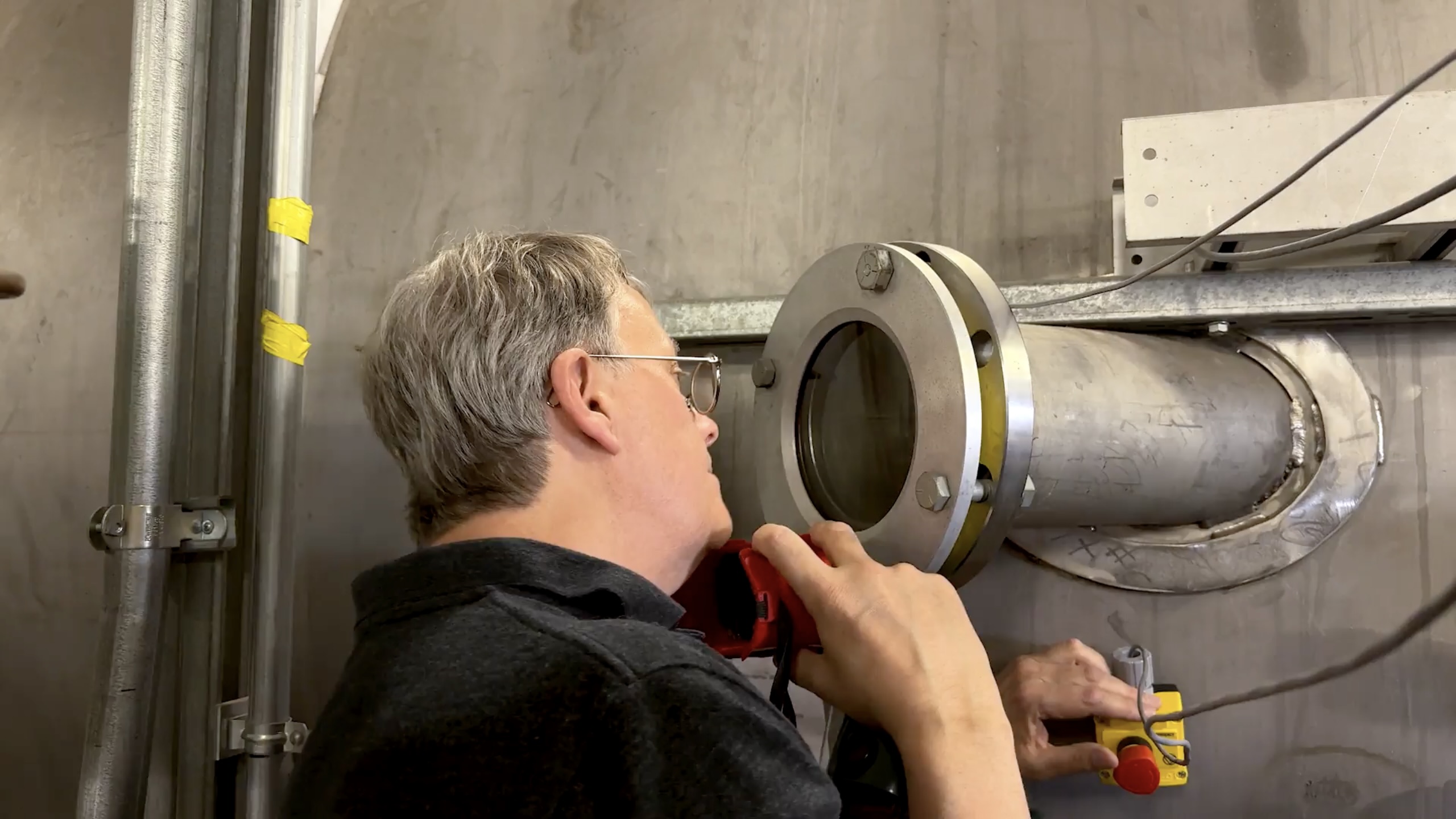
JPL senior research scientist James Polk peers into the condensable metal propellant (CoMeT) vacuum facility at JPL’s Electric Propulsion Lab, where a high-power electric thruster prototype his team developed was being put to the test in February 2026. Credit: NASA/JPL-Caltech
Powering up
Electric propulsion uses up to 90% less propellant than traditional, high-thrust chemical rockets. Current electric propulsion thrusters, like those powering NASA’s Psyche mission, use solar power to accelerate propellants, producing a low, continuous thrust that reaches high speeds over time. NASA JPL is testing a lithium-fed magnetoplasmadynamic (MPD) thruster, a technology that has been researched since the 1960s but never flown operationally. The MPD engine differs from existing thrusters by using high currents interacting with a magnetic field to electromagnetically accelerate lithium plasma.
During the test, the team achieved power levels of up to 120 kilowatts. That’s over 25 times the power of the thrusters on Psyche, which is currently operating the highest-power electric thrusters of any NASA spacecraft. In the vacuum of space, the gentle but steady force Psyche’s thrusters provide over time accelerates the spacecraft to 124,000 mph.
…
16 replies
 = new reply since forum marked as read
Highlight:
NoneDon't highlight anything
5 newestHighlight 5 most recent replies
= new reply since forum marked as read
Highlight:
NoneDon't highlight anything
5 newestHighlight 5 most recent replies
= new reply since forum marked as read
Highlight:
NoneDon't highlight anything
5 newestHighlight 5 most recent replies
Previous ion engines have favored very heavy atoms as propellant -- mercury or xenon. More atomic mass --
eppur_se_muova
Yesterday
#2
The NERVA engine used hydrogen, so (you know) lithium is heavier than that, but certainly lighter than mercury
OKIsItJustMe
Yesterday
#4
Hydrogen is being used there as ejectable mass, nothing more. It's handled by mechanical pumps and pressure.
eppur_se_muova
Yesterday
#5
Yes, I know that, thank you. In fact you're just repeating things I've already said in my replies. nt
eppur_se_muova
22 hrs ago
#10
Meanwhile, at a grossly overspent under intellectual trump supported SpaceX
3825-87867
22 hrs ago
#9
"It must have been a real pleasure to work out the mathematics of MPD for the first time..."
OKIsItJustMe
20 hrs ago
#16